Wednesday, August 26, 2009

August 25, 2009 – Candid photo

1/640f2.8ISO 20090mmRAW

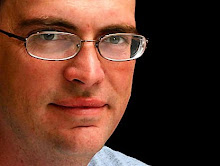
One of my good friends, Ramon, was inspired by the August 19 photo of the flowers and the bee, so he asked me to help him do the same thing during lunch yesterday. I tried to get some photos myself, but ultimately decided to snap a truly candid photo of Ramon as he was shooting.

By placing on the side of the photo, it lets you see what he is trying to photograph. The wide aperture (f2.8) blurs out the background, so the construction site in the upper left corner isn't distracting. Finally, the sunlight is striking the side of his body that is facing the camera, which really helps avoid his shirt and face being too dark.

Ramon is also showing good form in how he is holding his camera. He is down on one knee, supporting his upper body and camera by resting his right elbow on his knee.

By the way, I am not sure how my dates were off, but they were. Even though it may look like I have skipped a day, I haven't.

Tuesday, August 25, 2009

August 23, 2009 - Suwanee Town Center at night

1/10f5.6ISO 160020mmRAW

My wife, Rachel, has been encouraging me recently to do black and white photography, and this is my first attempt at accepting her challenge. Please let me know what you think of the shot.

I am by no means an expert on black and white photography, so I won't be offering much along the lines of tips for this kind of photography. It's something new to me, and it's always good to step out of your comfort zone and be willing to make mistakes as you learn something new. It's a great way to become a better photographer.

There was one really challenging aspect to this photo. One-tenth of a second is really slow (even for my IS lens, which helps offset camera shake at slow shutter speeds), and I didn't have a tripod. So what did I do? I braced myself to be as still as possible and then held down the shutter button to fire off several shots in succession. Out of the five shots taken, this is the middle one and it came out crystal clear. The others were all a little blurry.

I tried to frame the shot a little bit by having the solid brick wall on the left and the tall shrubbery on the right. This allows the curvature of the store fronts go three-quarters of the way into the photo, but prevents it from reaching the edge. This helps keep the viewers eye in the photo.

This was shot after 9 p.m. on a Monday night, so most of the shops were closed and few patrons were walking around. I might go back on a Friday or Saturday night and try this again with several pedestrians walking through the photo.

Monday, August 24, 2009

August 22, 2009 – Daisies in the morning sun

1/30f11ISO 10055mmRAW

I got out early Sunday to get some flower photos in the morning sun. I set my camera on a tripod and used my Canon EF-S 18-55mm f3.5-5.6 IS lens, which is also a decent macro lens.

Don't know what macro photography is? Don't worry — a lot of people don't. Simply put, macro photography is the art of taking closeup photos of small things, which allows you to see details not easily seen with the naked eye.

Using a tripod is vital for this kind of shot. As my friend Brian pointed out in one of his comments, the closer something is when you focus on it, the narrower the depth of field is. So in the instance of these daisies, they were about 10 inches from the lens. To get a deep enough depth of field, I needed to close the aperture down to f11.

I could have bumped up the ISO from 100 to 200 (which would have doubled the shutter speed from 1/30 to 1/60), but I wanted to have the cleaner image that ISO 100 would produce. Also, when you are hand-holding the camera at these short focus distances, a slight sway of a half-inch forwards or backwards can totally ruin the focus. Even at f11, you are dealing with such a narrow depth of field that a tripod is vital to hold the camera steady — not only because of the slow shutter speed, but also because you want an exact spot for the focus.

I shot this a little wide to give myself optimum flexibility when cropping the photo in Photoshop. This particular crop shows about half of the photo. I chose to crop it this way to implement the rule of thirds by putting the center of the flower a third of the way into the photo.

If you would like to try this with your camera, there are two options: most point-and-shoot cameras have a macro mode (which is usually represented by a flower icon) or, if you have a DSLR, you can buy a macro lens, which is specially designed to focus on items only a few inches away.

Point-and-shoot cameras can be great for macros since many of them will let you focus as close as two or three inches from the lens. As for DSLRs, some of the newest kit lenses (the one that might have come with your camera) will do for macros in a pinch because they also have a very short minimum focal range. For instance, the lens I used can focus to within five inches.

A couple of notes of warning, however. First, dedicated macro lenses (and point-and-shoot cameras set to macro mode) will have a focus range of only a few inches to a few feet. If you try to focus on something more than three feet away, your lens probably won't be able to. Second, this kind of work is best done under controlled circumstances. The more things that are out of your control (like wind and inconsistent sunlight), the more you will have to work. These flowers were actually in a vase, so as the sunlight moved through the trees I had to move the vase several times to keep it in the light

As for what I don't really like in the photo, there is a hot-spot nearly dead center where the detail in the yellow is lost in one petal. Also, I wish I had gotten the tips of the petals at the bottom of the photo in more focus.

Sunday, August 23, 2009

August 21, 2009 – Tennis portrait

1/400f2.8ISO 100175mmRAW

My two daughters have joined a tennis class, and couldn't be more excited. My wife, Rachel, has been asking for more photos of the kids, so I was happy to oblige. When I went to take the photo, however, I discovered a problem. There was a lot of stuff along the fence in the background that I didn't want in the photo, so I had to come up with a solution that would create a narrow field of vision.

I stood about 30 feet away from them and used a long telephoto lens (my 70-200mm f2.8L zoom lens) to focus on just them and leave out as much background as possible. I also put the camera in aperture mode (which should be an 'A' on your mode dial) and set it to 2.8. This wide aperture does a nice job in blurring out the background. So I had the best of both worlds — the long lens created a narrow field of vision that left out most of the clutter and the wide aperture made what was left (a bench) nice and blurry.

What also helped in the photo is most of the court was in the shade of some trees, so I had them stand in the shade in the middle of the court. There was plenty of ambient light coming down from the bright, open sky above them, which helped illuminate their faces and create a softer light that was void of harsh shadows.

Finally, a couple of more little tips. First, I knelt down to get the lens to their chest level. This subtle trick can really help make a difference in child photos. It also helped bring more of the fence into the background instead of the court surface. Second, I used the net as a sort of leading line into the photo. By placing my girls where they are, the net practically ends at them, which helps keep your attention in the center of the photo.

There's one huge thing I wish I would have done differently. It just seems awkward that my older daughter's hand is hanging limply in the middle of the photo. I should have asked her to hold the racket with both hands or drop her left arm down on the other side of the net. And while not as much of a problem, I probably should have had them swap sides and place the shorter one on this side of the net.

Saturday, August 22, 2009

August 21, 2009 – High-rise condominium

1/320f8ISO 10018mmJPEG

A couple of days ago I mentioned how the part of Buckhead I work in has done a good job of keeping green space amidst all of the high-rises. Here is a good photo showing that. At the base of this condominium is a little half-acre park, complete with bronze statues of kids playing (one of which you can see in the bottom left corner) and two water fountains.

I had to shoot with my lens set as wide as possible in order to get all of the building. There was quite of bit of building lean, which resulted in a tall, skinny pyramid look. Thank goodness for computers and Photoshop Elements camera distortion tool.

Another way to avoid the building lean is to get inside an adjacent building, go halfway up, and shoot your intended building through a window.

RAW versus JPEG

In my last posting, Sheree asked what RAW is and how you can get your camera to use RAW instead of JPEG. Instead of answering in the comment section, I decided to make a new post on the matter.

RAW is the true image data captured by your camera's image ship. If you shoot in JPEG mode (which most camera's do automatically), you are compressing the image data down into the JPEG format.

A lot of point-and-shoot cameras don't give you the option to shoot RAW, and if you have a camera that does then you need software on your computer that can read the RAW data.

Fortunately, Photoshop Elements has a very good RAW editor. It's what I use most of the time. If you don't have Photoshop, then your camera may have come with RAW editing software.

RAW takes a little getting used to because the files are larger and they take your computer a few seconds longer to upload and process. But you have more options and get better results when working with a RAW file.

For a better explanation of what RAW is, how it can make your photos better, and some of the drawbacks of shooting RAW, see this article that I wrote about the subject.

As for how to get your camera to shoot RAW, you will have to refer to that dreaded manual that came with your camera. You know, that little booklet you have never really looked at, even though you probably have a little voice in the back of your head that keeps saying you should.

Friday, August 21, 2009

August 20, 2009 – Party on the deck

1/125f11ISO 20018mmJPEG

Our company (HowStuffWorks.com) just launched the first portion of our social networking platform, so we had a party out on the deck (15 floors up) to celebrate. The weather was nice, but really overcast.

I wanted to get a photo that would capture how beautiful the view of the other buildings can be, but also capture the fun everyone was having. That was hard, and here is what I thought was my bast effort.

I shot this at a small aperture (f11) in order to get the people in front (who were about 18 feet away) in focus along with all of the buildings in the back. I might have been able to use a wider aperture, but they were laughing and I didn't have much time to react. So I went with an aperture I knew would do the job.

I used Photoshop Elements to correct most of the distortion from the wide angle shot. I also cropped the photo in a way to leave out the large trash can that was by the table of food on the right.

There were a couple of things I think that could have made this photo better. First, I should have shot it in RAW mode for more post-processing control over the exposure, contrast, and color. But alas, I had left it in JPEG mode after shooting the bees the day before. Second, I wish there were another couple of people talking in the empty space where you can see the tower crane. Ideally, I would have liked them to have been 15-20 feet from the camera.

August 19, 2009 – Flowers and Bees

1/2500f2.8ISO 400150mmJPEG

I really work in a beautiful area. It's in the heart of Buckhead, a thriving live-work-and-play area of northern Atlanta. It is dominated by high rise hotels, office buildings, and condominiums. But despite all the concrete and steel, they have done a good job of preserving some green space, too.

I shot this honeybee among a large swath of flowers about 100 yards from my building. I used my 70-200 f2.8L lens to get a clear, sharp, and fast photo. The day was mostly cloudy and the sun was ducking in and out from behind clouds quite a bit. So I left the lens wide open and used ISO 400 to get a fast enough shutter speed for when the sun was blocked.

This shot was in the full sunlight, so it resulted in a really fast shutter speed. But it wasn't fast enough to stop the bee's wings. The blur really drives home that the bee is hovering over the tiny flowers.

This kind of shot is a lot of hard work, but the reward can be great. I shot about 300 photos in 30 minutes, trying to get just two or three like this one, where the bee is actually flying between flowers. You will probably agree, a photo of a bee flying will beat a one of a bee walking any day.

I had to shoot these as JPEGs instead of RAW because my camera will shoot 20 JPEGs in succession, but only 8 RAW images. I would start shooting when I thought the bee might jump off of the flowers and fly to the next batch. If I misjudged (and I did a lot), I would wait for my camera's memory buffer to empty and then shoot a bunch more.

Wednesday, August 19, 2009

August 18, 2009 – Breakfast for dinner

1/50f5.6ISO 80050mmRAW

We decided to have a simple dinner tonight, so we whipped up some pancakes. They were absolutely scrumptious – thanks, Rachel! – so I wanted to share them with you.

I shot this with my 50mm f1.8 lens, which is really sharp. By pumping up the ISO, I could close the aperture a little to get more depth of field (but not too much). This also allowed me to handhold the camera without risking camera shake. I shot RAW so I could tweak the color to the golden hue I wanted.

The color was harder than I thought it would be to get it just right. I can see why commercial food photographers use strobes and flashes because the natural lighting was too mixed up for me to easily find the right color.

Monday, August 17, 2009

August 17, 2009 – Suwanee City Hall

1/250f8.0ISO 20035mmRAW

I was driving home from a canceled Boy Scout training session and I noticed the beautiful bank of clouds being lit up by the early evening sun. It's the kind of setting where you want to find something nice to put in front of it, so I thought of the recently finished Suwanee City Hall.

As I was parking, I looked for where I thought would be the best perspective. I also noticed that the sun was dangerously close to going behind some clouds, so I knew I didn't have much time. I literally ran to a spot that, while not my choice for the best location, would let me get a good shot as soon as possible. I then went to the spot I had picked out initially and got some more photos.

When I got back home and looked at all of the shots, the first one turned out to have the best combination of clouds, color, and composition. It reminded me of something I read about how Ansel Adams got his Moonrise photo.

He was traveling down the highway when he noticed the moon rising over the mountain and the village in the evening light. He slammed on the brakes, pulled over, and hopped out with his gear. He feared there wasn't enough time to measure the light and determine the proper exposure, so he made his best guess and took the photo. Then he went through his normal process to take a photo, but before he was done the light was gone.

Adams probably drove away thinking he had missed a perfect opportunity for a wonderful photo, but we all know now that he didn't. One of his most famous photographs was a guess – a well-educated guess, mind you – but a guess all the same.

The main lesson to learn here is to pay attention to your surroundings and don't be afraid to snap off a quick shot at something that looks great. You never know when that moment may be the only chance you've got. Then take the time to make sure you have everything set for a great photo.

I shot this at f8 to get a really sharp photo, and then focused about two-thirds into the scene (around the water fountain in the front) to make sure everything was in focus, from front to back. I also shot it a little loose so I could crop it in the way I wanted once I got it loaded on the computer. Finally, I followed the rule of thirds by putting the building down in the lower third of the photo, which helps place more emphasis on the cloud formation above it.

In order to avoid a slanted effect (where the sides of the building seem to slant towards each other), I purposefully went up the slope in front of the building in order to be standing more on an equal elevation. You can see the camera level is just above the awning over the front doors. This way I was aiming the camera straight ahead instead of aiming it slightly upwards, which would have created the slanting sides of the building.

I really like this photo. Some of the impact is lost here in the small version, but the full-blown shot is fantastic. The only regret I have is something out of my control. I wish the clouds were more puffy and separated, instead of one massive cloudbank.

August 16, 2009 – Movie night

4 secf4.0ISO 20025mmRAW

Last night the girls were crowded around the TV watching Coraline, a claymation movie that reminded me a lot of Tim Burton's The Nightmare Before Christmas. Thanks to the spooky nature of the film, my youngest snuggled up to her older sister, and my next youngest grabbed one of her favorite stuffed animals, Bedtime Bear.

I turned out all of the lights and set up the camera on a tripod right beside the TV. I took a bunch of shots (since the TV was putting out varying amounts of light, depending on what was being shown in the movie) in order to find a few goods one where the kids didn't move.

I used a low ISO to avoid noise/grainyness, and purposefully picked a shot that was a little underexposed to reinforce the idea of watching a movie in the dark. Finally, I cropped it to a wide 2 to 1 ratio to emphasize the kids and eliminate most of the distracting background.

In all, I like the photo. But others may think it could have been better if all the girls were sitting side by side. I wasn't going to pose them, however, because I wanted to capture more of their natural tendencies. Some may wonder why my 9-year-old is sitting off by herself on the right. To me, it fits here independent personality perfectly.

Saturday, August 15, 2009

Car repairs

1/100f4.5ISO 40021mmRAW

A friend came over yesterday to fix my air conditioner. By the time I thought of taking some photos, he was wrapping up and putting everything back together.

It was a cloudy morning, so I shot this without a flash because the diffused light was doing a great job to evenly illumniate the shot. I wanted the photo to instantly convey "engine repair," so I got in real close and shot at a wide angle. This left only the engine compartment and the mechanic in the photo.

This would make a good stock photo, except for possibly one thing. The dip stick shaft is laying across the top of the engine in the top right corner of the photo. It's something that most people wouldn't notice, but once seen it might have the tendency for the viewer to wonder why it's there. I should have removed it before taking the photo.

And in case you are now wondering, here's what happened. In order to pull out my broken air compressor, he had to squeeze it past the dip stick shaft. The shaft snapped under the pressure.

Dinner date at home

1/15f4.5ISO 80018mmRAW

My wife and I had a dinner date at home, after the kids went to bed. We grilled up some New York Strip steak, along with some loaded baked potatoes and asparagus.

I shot this with my 18-55mm IS lens, which allowed to go handheld without a flash -- even with such a slow shutter speed. Even with the IS lens, I made sure to hold my elbows in close to my chest, control my breathing, and just squeeze the shutter.

Shooting RAW helped me with the color cast from the indoor lamps. The wide f4.5 aperture helped put the background plate nicely out of focus.

In hindsight, I wish I would have turned the plate so the steak was place in the 12 o'clock to 4 o'clock position (instead of the 8 o'clock to 12 o'clock position it is currently in. This would have made the steak larger in the image instead of the potatoes.

Starting a 365 photo project!

I have really neglected this blog, but have been struggling to figure out what can motivate me to start posting again.

I think I have hit on it. I am going to start a "365" project, where I post one photo that I have taken the previous day. I will also explain what I did to get that photo.